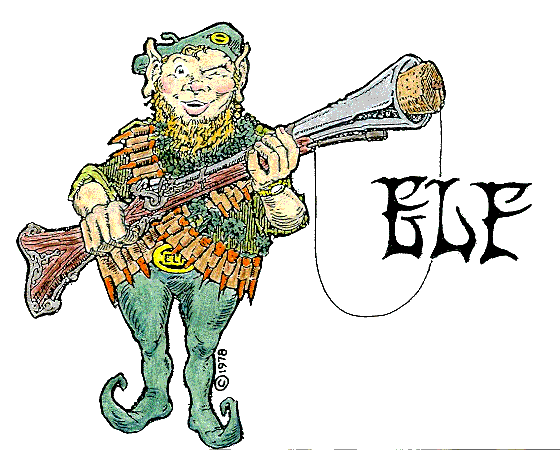
The original ELF initiated its first action on March 16, 1977 in Watsonville, Santa Cruz County, California. Subsequent guerrilla attacks in northern California and Oregon were mounted that year by the May Day Ecommando Unit and the Rachel Carson Ecommando Unit. On November 22, 1977, John Hanna, the founder of ELF, was arrested at his home in Santa Cruz by the local sheriff's SWAT team and federal agents of the Bureau of Alcohol, Tobacco and Firearms. A trial in federal court resulted in a five year sentence which was later modified to time served and probation. Following the 1977 arrest, a period of self-criticism and introspection ensued. A dialogue with other activists led to a consensus that terrorist actions were clearly counter-productive to the environmental movement - regardless of the perceived righteousness of a given cause. The public will always reject violence and destructive actions. Although the original ELF's attacks were later described as being "symbolic" and "guerrilla theater" the public's reaction was overwhelmingly negative. Since ELF had strived to inform and inspire the people, this negative response served to end its activities. The original ELF disbanded in 1978, having failed to achieve its objective. One year later, Earth First! was founded. In the mid 1980's, there were written communications between ELF founder, John Hanna, and Earth First! founder, Dave Foreman (see: Archives page). At the time, the internet did not exist, so information about the 1977 ELF guerrilla actions circulated slowly within the Earth First! membership. The current version of ELF (Earth Liberation Front) was launched in the UK in the early 1990's by a radical EF! member who was a long-time acquaintance of John Hanna. The two had met in Glasgow, Scotland in 1962 and had kept in contact over the years. The Earth Liberation Front's philosophies and tactics generally mirror those expressed by the original ELF founder, John Hanna. Unfortunately, a U.S. iteration of the Earth Liberation Front in the early 2000's, made no attempt to "inform and inspire the people". The new ELF's actions in the U.S. were violent, intimidating and counter-productive to the environmental movement. It does not matter that throughout its history, none of the ELF's direct actions have ever physically harmed a single person. The lessons of the past were not learned by this reinvented ELF cadre in the states. In the early 2000's, the FBI's "Operation Backfire" was the net result of not learning from the past. Today's mainstream environmentalists choose to distance themselves from violence perpetrated in the name of environmental direct action. For the same reasons given forty-seven years ago, mainstream environmentalists and the majority of all the world's people fully reject those who attempt to advance their environmental cause "by any means necessary". There is no tolerance for terrorism in the environmental movement - never has been and never will be. A terrorist and environmentalist cannot live within the same skin.
The following interview took place in Greeley, Colorado just five days before the September 11, 2001 terrorist attacks led by 15 Saudi Arabian psychopaths and camel humper Osama bin Laden...
INTERVIEW WITH ELF FOUNDER, John Clark Hanna
Q: You've been out of the spotlight for a number of years. Why did you decide to give this interview?
A: I started hearing about attacks and vandalism claimed by an environmental group called E.L.F. Years ago, I founded the ELF. Of course this is a whole new entity but similar in its purpose. I felt it might be useful to make a statement at this time.
Q: On November 22, 1977, agents of the Alcohol, Tobacco and Firearms arrested you at your home in Santa Cruz, California. Can you describe the circumstances leading to your arrest?
A: I was charged with violation of federal statutes. Specifically, I was accused of placing incendiary devices on seven crop dusters at the airport in Salinas, California on May 1, 1977. There were other charges as well relating to my underground activities.
Q: What prompted you to take that course of action?
A: At the time, I was frustrated. I chose to go underground and employ guerrilla tactics in defense of the earth. I felt conventional methods of civil disobedience were ineffective. I was upset because pesticide use and cancer rates were increasing in spite of the best efforts of the concerned scientific community to point out the hazards and alternatives to pesticides.
Q: To whom are you referring?
A: Two people influenced me: One was Rachel Carson and her book Silent Spring. The other was Robert Van Den Bosch, professor of entomology at U.C. Berkeley. He wrote a book titled The Pesticide Conspiracy. He died shortly after the book was published.
To continue with interview, click HERE